
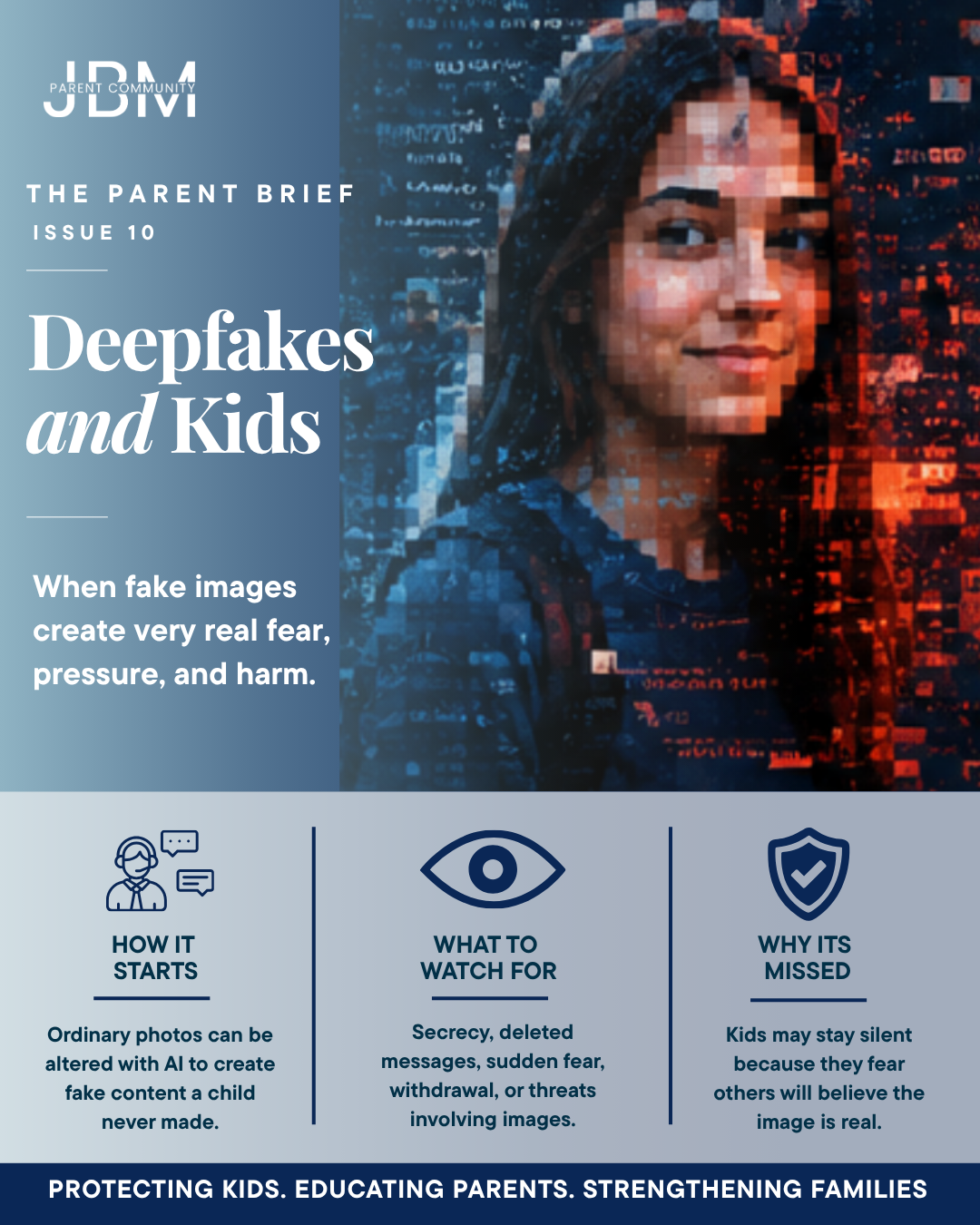
DEEPFAKES AND KIDS
When Fake Images Cause Real Harm
Your child does not have to send an explicit photo to be threatened with one.
AI can turn an ordinary photo from social media, a school website, a sports team, or a group chat into fake sexualized content.
The child never created it. They never sent it.
But they can still become the target.
Deepfakes are becoming a child-safety issue because fake content can be used to embarrass, bully, threaten, blackmail, or pressure a child.
This issue will help you understand how deepfakes are being used against kids, what parents should watch for, and how to respond if your child is targeted.
PARENT BRIEF | ISSUE 10
A CLOSER LOOK
A CHILD DOESN'T HAVE TO SEND THE IMAGE
A deepfake is AI-created or AI-altered content that makes it appear someone said or did something they never did.
For children, the concern is increasingly personal.
An ordinary photo can be taken from social media, a school website, a sports team page, or a group chat and altered using AI. “Nudify” tools can create fake sexualized images from completely normal photos.
Those images can then be shared, posted, or used to threaten the child.
And it isn't always a stranger.
A classmate, teammate, former friend, dating partner, or someone in a group chat may already have access to the photos needed to create something harmful.
The image may be fake. The fear, humiliation, and pressure a child experiences are not.
WHAT PARENTS SHOULD WATCH FOR
WHEN A FAKE IMAGE BECOMES LEVERAGE
Deepfakes become especially dangerous when someone uses the image to control what happens next.
01 — SUDDEN FEAR AROUND A PHONE OR ACCOUNT
Your child becomes anxious when messages arrive, hides their screen, deletes accounts, or suddenly changes profiles.
02 — WITHDRAWING FROM SCHOOL OR FRIENDS
They begin avoiding school, activities, teammates, friends, or other places where they normally feel comfortable.
03 — UNKNOWN ACCOUNTS OR REPEATED MESSAGES
New accounts begin contacting them, messages become threatening, or someone repeatedly finds ways to reach them after being blocked.
04 — MONEY OR OTHER DEMANDS APPEAR
Someone demands payment, additional photos, sexual content, or another action in exchange for not sharing the fake.
05 — SHAME OR PANIC APPEARS QUICKLY
Your child becomes unusually anxious, embarrassed, withdrawn, or afraid of what other people may have seen.

The question is not only, “Did my child send an image?”
Ask, “Could someone be using an image my child never created to pressure or control them?”
TAKE ACTION
WHAT PARENTS CAN DO RIGHT NOW
CHECK THEIR DIGITAL FOOTPRINT
Look together at public profiles, tagged photos, school or team websites, and other places clear images of your child may be publicly available.
TIGHTEN PRIVACY
Review who can view, tag, save, message, or share your child's content.
CHANGE THE CONVERSATION
“Don't send inappropriate pictures” is no longer enough. Tell your child that someone can create something fake about them—and that they can always come to you.
CREATE A RESPONSE PLAN
Teach your child not to respond, negotiate, pay, or send additional content if someone threatens them.
MAKE HOME SAFE FOR THE TRUTH
Tell them now:
“If someone ever makes, sends, or threatens you with a fake image, you are not in trouble. Come to me. We will handle it together.”

A REMINDER FOR EVERY PARENT
THE GOAL IS NOT FEAR—IT IS PREPARATION.
You cannot prevent every photo from being copied, altered, or misused.
But you can make sure your child knows what to do if it happens.
Stay calm. Save evidence. Stop contact. Report the situation. And make sure your child knows that a fake image does not change who they are.
The technology may be new. The need for a safe, trusted parent is not.
PRACTICAL TOOLS FOR PARENTS
FEATURED RESOURCES
DEEPFAKES & KIDS
Parent Guide + Response Plan
A practical guide to help parents understand how deepfakes can be used against children, reduce unnecessary digital exposure, recognize warning signs, and know what to do if their child is targeted.
SHARE THIS RESOURCE
Know a Parent Who Needs This Conversation?
Share this Parent Brief with a parent, grandparent, educator, coach, youth leader, or trusted adult in your community.
A child does not have to create or send an explicit image to become the target of one.
The more adults understand how AI-generated images can be used to shame, threaten, or control children, the better prepared we are to respond when a child asks for help.
Fake content can have real consequences. Preparation gives families a place to start.
With you,
The JBM Parent Community