

PARENT BRIEF | ISSUE 15
WHO’S DOING THE THINKING?
AI can help your child create impressive work. But who came up with the idea, made the choices and figured out what needed to change?
An essay sounds polished. A project has a clever concept. Your child finishes homework with less frustration.
That can feel like progress. But a finished assignment doesn’t always reveal what your child understands—or which skills they practiced along the way.
The handoff can happen before AI writes a single paragraph. It can happen when a child asks it to choose a topic, develop an opinion or decide how a story should end.
These are moments when children have opportunities to discover what they think.
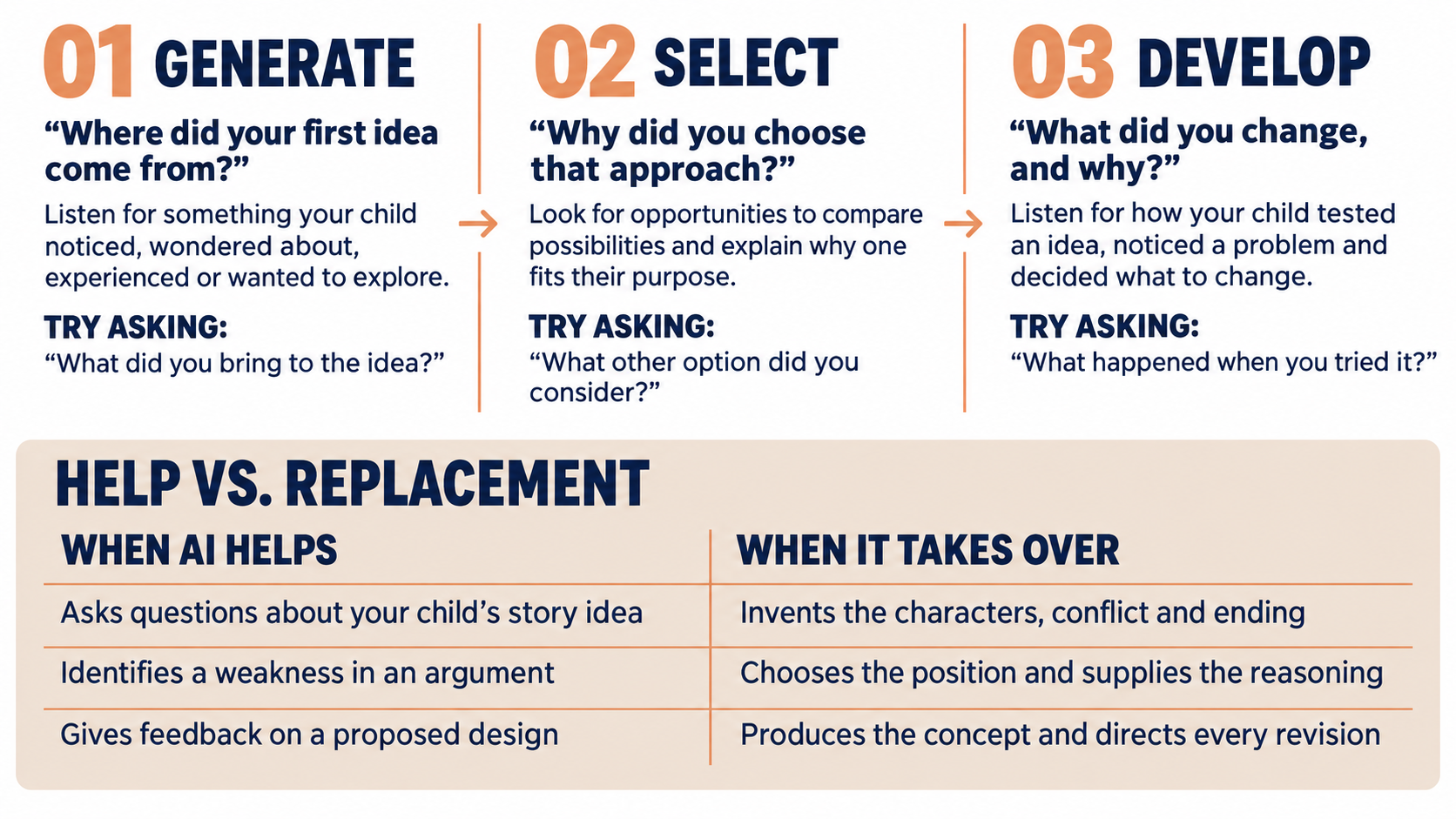
As AI becomes part of everyday life, look beyond the finished product: Who generated, selected, and developed the ideas?
We teach prevention, but rarely teach recovery.
We teach kids what not to click, who not to talk to, and what not to share.
But eventually, many kids will see something they wish they hadn't—violent, sexual, frightening, hateful, shocking, AI-generated, or simply something they weren't developmentally ready to see.
When that happens, does your child know what to do next?
THE THINKING BEHIND THE WORK
WHAT AI MAY BE TAKING OVER
CREATIVITY IS MORE THAN MAKING SOMETHING LOOK GOOD
Creativity includes asking interesting questions, imagining possibilities, connecting experiences, and deciding what to try. Innovation adds another step: testing an idea and improving it so it works.
These abilities draw on cooperating brain networks involved in imagination, memory, attention and evaluation. There is no single “creative part” of the brain.
When a child designs a bridge, they imagine a shape, choose materials, discover a weak point and change the design. The bridge matters, but so do the decisions made while building it.
If AI supplies the design and every correction, the child may produce a stronger bridge while making fewer of those decisions.
BEFORE AI HAS AN IDEA, DOES YOUR CHILD GET TO HAVE ONE?
Give their first thought room to exist before introducing a polished suggestion.
WHAT THE RESEARCH SHOWS
In an adult writing experiment, AI-generated ideas helped participants produce stories rated as more creative. However, the AI-assisted stories were also more similar to one another.
Research into children’s brains and AI remains early. Current findings do not establish that AI permanently harms children’s brains or creativity.
THE CONCERN FOR PARENTS IS MISSED PRACTICE.
Notice which choices, questions, and revisions your child is still doing.
Sources: Beaty et al., PNAS (2018); Doshi & Hauser, Science Advances (2024); Horowitz-Kraus et al., Cerebral Cortex (2026
LOOK BEYOND THE FINISHED PRODUCT
THREE QUESTIONS THAT REVEAL THE THINKING
Start with curiosity. These questions help you understand the process without turning every assignment into an investigation.
The screen may be off, but what your child saw may still be on their mind.
A child may close a disturbing video, put down their phone, and seem completely fine. But later that night—or even days afterward—they may replay what they saw, feel frightened, or struggle to make sense of it.
WHICH SKILL IS YOUR CHILD SUPPOSED TO BE PRACTICING?
Choose help that preserves that practice.
GIVE THEIR IDEAS ROOM TO GROW
HOW TO GROW AN ORIGINAL THINKER

NOTICE THEIR DECISIONS
PROTECT THE FIRST ATTEMPT
Invite your child to sketch, talk, dictate, or write a starting idea before asking AI. An unfinished thought gives them something of their own to develop.
“Let’s hear your version first.”
EXPLORE ANOTHER POSSIBILITY
Ask for another solution, explanation or ending. Keep it playful, not like every activity is another assignment.
“What’s another way we could try this?”
MAKE, TEST AND TRY AGAIN
Build, cook, repair or invent together. Let your child notice what happened and choose what to change.
“What did that tell us?”
“You tried a different material when the first one bent.”
Show interest in the thinking behind the result.
KEEP NEEDED SUPPORTS IN PLACE
Dictation, reading supports, visual plans and smaller steps can help children express their own ideas. Keep accommodations available and adjust the challenge when your child is overwhelmed.
Leave meaningful choices in their hands.
FAKE DOESN'T ALWAYS MEAN HARMLESS
AI can create convincing images, voices, and videos. Even when content isn't real, it can still cause fear, humiliation, confusion, or harm.
“It's AI” doesn't mean “it doesn't matter.”

CHECK AGAIN LATER
One conversation may not be enough.
A few days later, ask:
“Has it popped back into your head at all?”
If distress continues or interferes with everyday life, consider talking with a qualified trauma specialist.

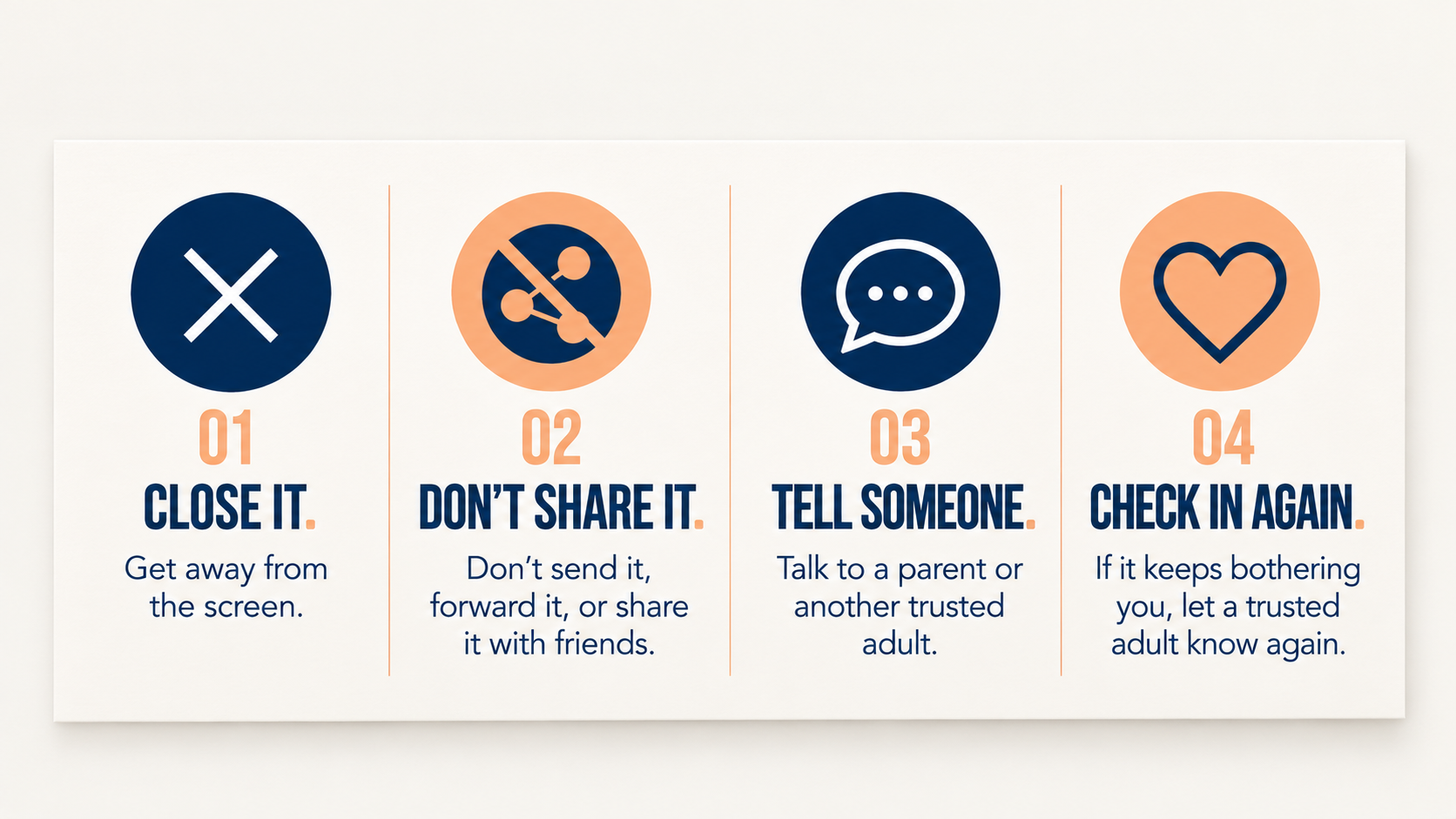
WHAT DO I DO NOW
A SIMPLE PLAN YOUR CHILD CAN REMEMBER.
Kids may eventually see something online that is disturbing, confusing, or upsetting. Knowing what to do next can help them feel safer and more in control.
Use this simple four-step plan to talk with your child and practice it together:
Know another parent, grandparent, educator, or caregiver who could benefit from this information?
Share this Parent Brief with them. One simple conversation could help a child know what to do when they encounter something disturbing online.
Awareness is not fear. It is wisdom.
With you,
The JBM Parent Community